Sequenz, räumlich
Sequence, in space
Neon, Aluminium, Acryl. Über die räumliche Übertragung der Sequenz.
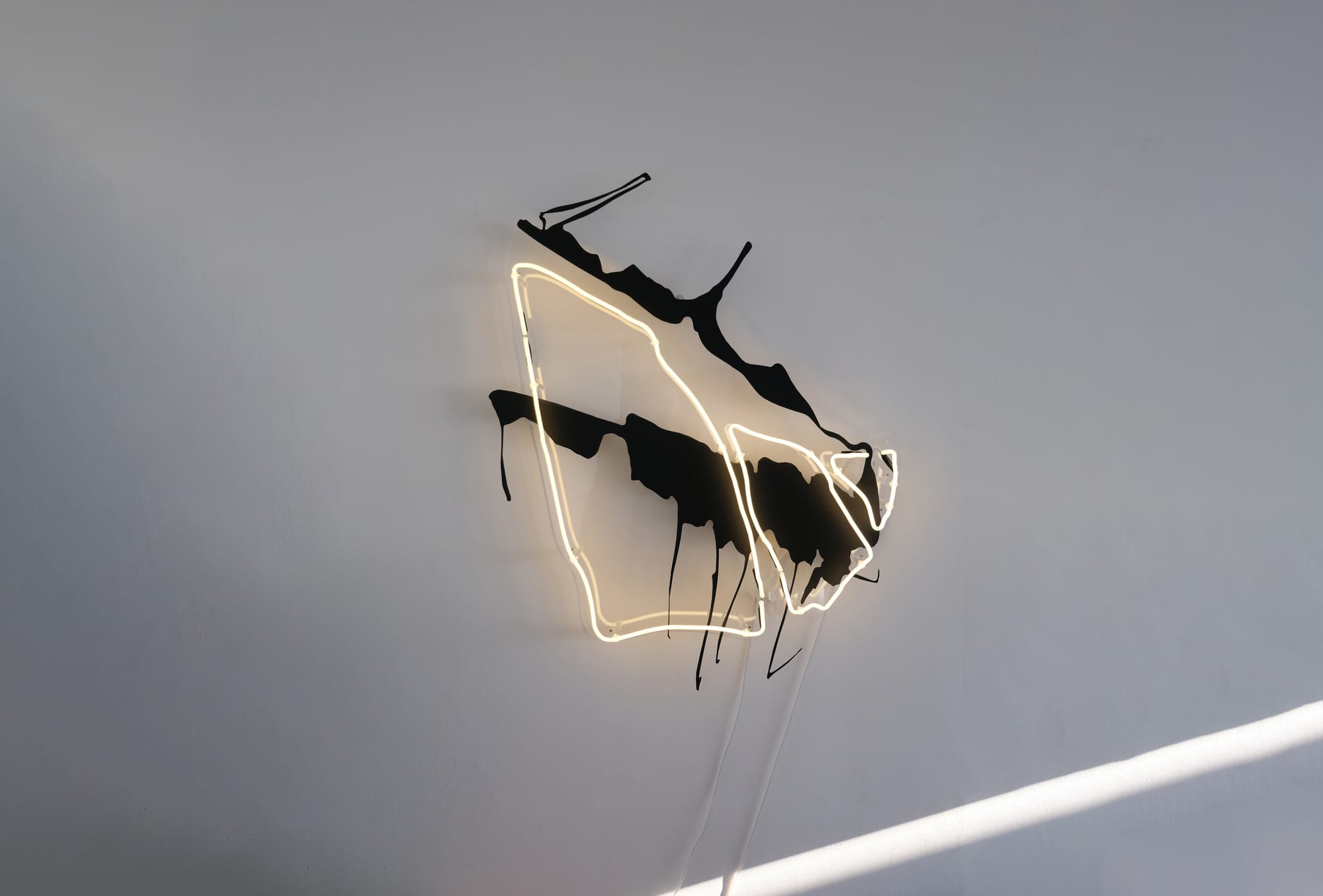
Die Lichtarbeit verlegt die Sequenz der Papierarbeiten in den Raum. Weißes Blatt, Tinte, Blattmetall — dieselben drei Systeme, anders verkörpert.
Das Acryl entspricht dem Weiß — nicht mehr Grund, sondern transparente Bedingung. Die schwarze Form, eingefasst in eloxiertes Aluminium, ist die fixierte Tinte: Index einer Geste, die vergangen ist. Die Neonröhre folgt dieser Form und verdoppelt sie zugleich; was im Blatt als Linie aus Kupfer oder Blattgold liegt, ist hier Licht — und greift hinter das Werk in den Raum.
Was sich verschiebt, ist die Zeitlichkeit. Auf dem Blatt vollzieht sich die Sequenz einmal und bleibt: Die Tinte trocknet, das Gold liegt an, das Gleichgewicht ist gesetzt — als Zustand, nicht als Ende. Im Raum wird dieser Vorbehalt materiell. Das Licht ist nicht gegeben, es ist gehalten. Solange es brennt, antwortet es der schwarzen Form; sein Halt ist endlich. Erlischt es, bleibt sie allein.
Die Lichtarbeit ist nicht eigenständige Lichtkunst, sondern Fortsetzung der sequentiellen Papierarbeiten im Raum. Sie führt aus, was im Blatt als Geste vollzogen wird: das Setzen einer Antwort, deren Halt nicht garantiert ist. Im Papier bleibt diese Bedingtheit konzeptuell. In der Lichtarbeit ist sie materiell — eingelassen ins Werk, nicht hinzugesetzt. Die Arbeit handelt nicht von Bedingtheit. Sie ist Bedingtheit, als Material.
The light work moves the sequence of the paper works into space. White sheet, ink, metal leaf — the same three systems, embodied differently.
The acrylic corresponds to the white — no longer a ground but a transparent condition. The black form, set in anodised aluminium, is the fixed ink: index of a gesture now past. The neon tube follows this form and doubles it at once; what lies in the sheet as a line of copper or gold leaf is light here — and reaches behind the work into space.
What shifts is temporality. On the sheet the sequence occurs once and stands: the ink dries, the gold settles, the equilibrium is set — as a state, not an end. In space this caveat becomes material. The light is not given, it is held. As long as it burns, it answers the black form; its holding is finite. When it goes out, the form remains alone.
The light work is not autonomous light art but a continuation of the sequential paper works in space. It performs what the sheet sets out as gesture: the placing of an answer whose hold is not guaranteed. On paper this conditionality remains conceptual. In the light work it becomes material — set into the work, not added to it. The work is not about conditionality. It is conditionality, as material.